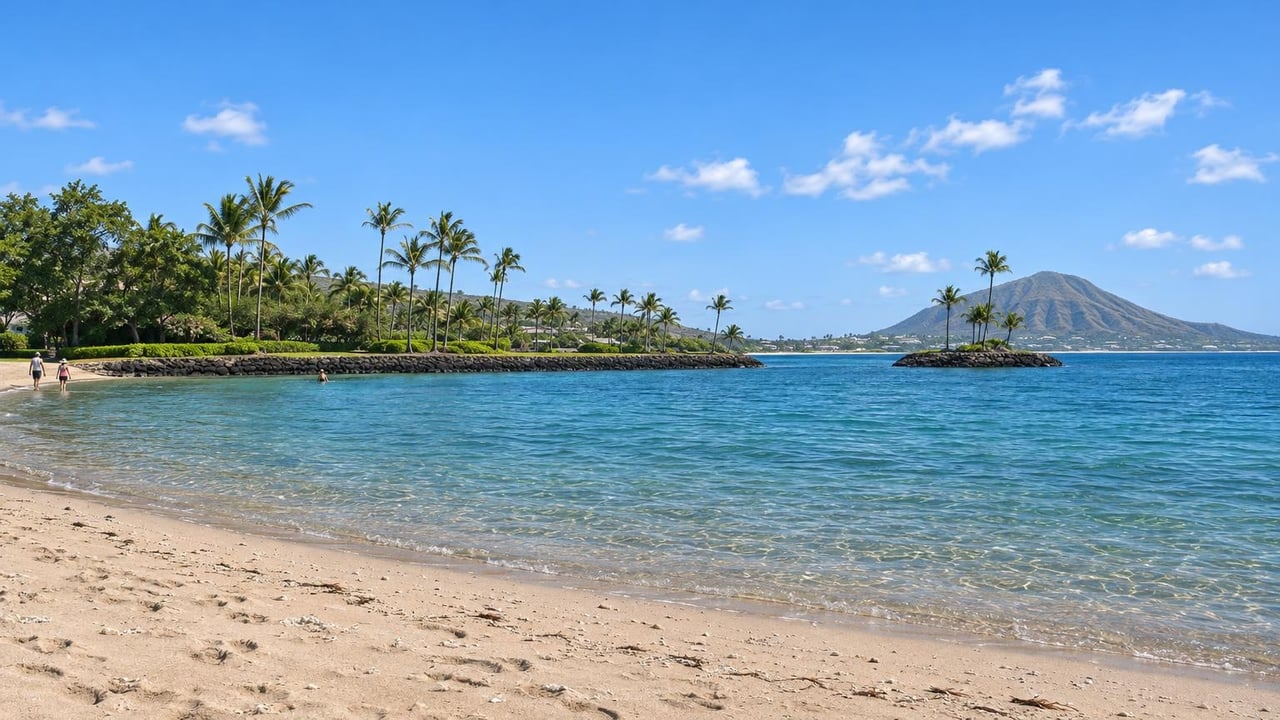
From the Hunakai Lane to Waialae Beach Park, Kahala Beach Still Has Sand
November 26, 2026
November 26, 2026
Denby Fawcett grew up at 4523 Kahala Avenue in the 1950s. In a Civil Beat column published November 19, she wrote that the beach out front was once wide enough that she and her friends could ride horses all the way from Black Point to Waialae Country Club. In the same column she writes that the sand in front of her family's old house is gone and is underwater even at the lowest tides.
You can't walk the whole shore in one stretch anymore. Kahala Beach is now a string of separate pockets, and which access lane you take decides what you get. This winter, the stretch with walkable sand runs from the public right-of-way at Hunakai Street to Waialae Beach Park. If you're heading out for a morning walk with or without a dog, start at the park and walk west.
None of the beach rights-of-way along Kahala Avenue has dedicated parking, according to the state's shoreline public access inventory. The three Koloa Street lanes carry "No Parking" on their signs. Waialae Beach Park is the one stop on this shore with real amenities. The same inventory lists 41 parking stalls, restrooms, showers, picnic facilities, drinking water and trash cans, and no lifeguard. The City's park closure hours list the Waialae Beach Park lot as closed from 10 p.m. to 5 a.m., so a sunrise walk can begin from the lot any day of the week.
At the September 17 meeting of the Waialae-Kahala Neighborhood Board, a member asked about an old backhoe blocking the canal bridge at the park's Kahala Avenue entrance. A City deputy director said she would look into it, according to the board's minutes. If you drive in, watch that entrance.
Each lane reaches a different kind of shore. Going east from Diamond Head, the state inventory lists them in this order.
Those descriptions date from 2013, and the inventory reflects an earlier survey, so read them as how these lanes have long been known, not as a report from this week. The names and sign numbers are still handy when a friend says to meet at "the Koloa lane" or "Mother's."
Hunakai is the lane that matters this season. Fawcett walked the beach with Lucinda Pyles, a Kahala resident of 51 years who has photographed it for decades. Fawcett writes that the stretch from the Hunakai right-of-way to Waialae Beach Park still has sand, with some sections in worse shape than others. West of Hunakai, toward the 4500 block where she grew up, seawalls meet the water directly.
The sand that remains doesn't look the way it once did. Fawcett describes it as often beige rather than white, with clumps of vegetation and landscaping debris along the shore. In June, the Honolulu Star-Advertiser reported on one lot near the Hunakai path where palm stumps, root balls and broken irrigation pipes blocked anyone walking along the beach. The state sent notices to beachfront owners in this section earlier in the year, and according to Civil Beat, several owners have since removed the debris on their stretch of beach.
Turnaround points on this stretch go back further than this year. In May 2024, the Star-Advertiser reported that a morning dog walk along Hunakai Beach was ending every day at a collapsed yard that spilled across the shore. If you walk out from Waialae Beach Park toward Hunakai, plan on finding a spot where you turn around. Where that spot falls depends on the tide.
Hawaii Ocean Safety describes south shores as generally flat to small from November through April, while summer from May to October brings frequent south swells.
In front of Kahala the reef flat is more than 850 feet wide, according to a 2010 shoreline assessment filed with the state. Large waves usually break out on the reef before they reach the beach. The same study found that low tide opened up the walk along the shore even where little sand was left, and it listed wading fishermen, seaweed gatherers and spearfishers among the people using the flat. Fawcett and Pyles walked the beach at low tide for the November column, and Pyles photographs it at low tide. Check a tide chart before you leave, and the Hunakai-to-park stretch will usually give you the most room.
The one piece of news that could change this walk comes from the beachfront owners themselves. Civil Beat reports that one Kahala Avenue homeowner has hired coastal engineer Michael Foley of EA Engineering to design a dune restoration system. The homeowner hopes the seven neighboring owners who received similar state letters will join in building one continuous dune planted with native coastal vines and grasses. The June Star-Advertiser story quoted a local coastal engineer on the project, who said it could become a model for neighboring landowners.
Foley told Civil Beat that the effort needs the whole neighborhood. "This problem is greater than one property owner or even several can address. We, as a community, all need to work together to improve our coastal environment," he said. The owners of 4631 Kahala Avenue told the outlet they want to join the effort. If the dune gets built, it would rise at the makai edge of the 4600 block, inside the same stretch you walk from the park toward Hunakai.
Many people walk this stretch with a dog, so one more neighborhood board item is worth following. At its October 15 meeting, the Waialae-Kahala Neighborhood Board heard a letter from the Department of Parks and Recreation. The department proposes adding Waialae Beach Park to Phase 2 of its on-leash dog-friendly parks, along with Ainakoa Neighborhood Park and Operation Red Wings Medal of Honor Park in the same district. That is according to the draft minutes. Phase 1 in February 2026 added 36 on-leash parks citywide, and the department plans to announce the Phase 2 results in early 2027.
The board chair explained that the proposal allows only leashed dogs and changes none of the park's facilities. One member noted that Waialae Beach Park is already dog friendly, and another noted that Kahala Beach itself isn't part of the proposal. Before taking a position, the board asked for more community input and a presentation from the department. If you walk out from the park with a dog most mornings, the Waialae-Kahala board's monthly meetings are where that input goes.
At our Hawaii LUX Team ohana, we follow what happens between the Hunakai lane and Waialae Beach Park because it is part of what a Kahala Avenue home is. If you own along Kahala Avenue and want to talk through what your stretch of beach means for your home's value, start with a Kahala home valuation, or browse more of our Kahala Area neighborhood coverage.
November 26, 2026
November 19, 2026
November 12, 2026
November 5, 2026
October 29, 2026
October 22, 2026
October 15, 2026
October 8, 2026
October 1, 2026
Get assistance in determining current property value, crafting a competitive offer, writing and negotiating a contract, and much more. Contact us today.