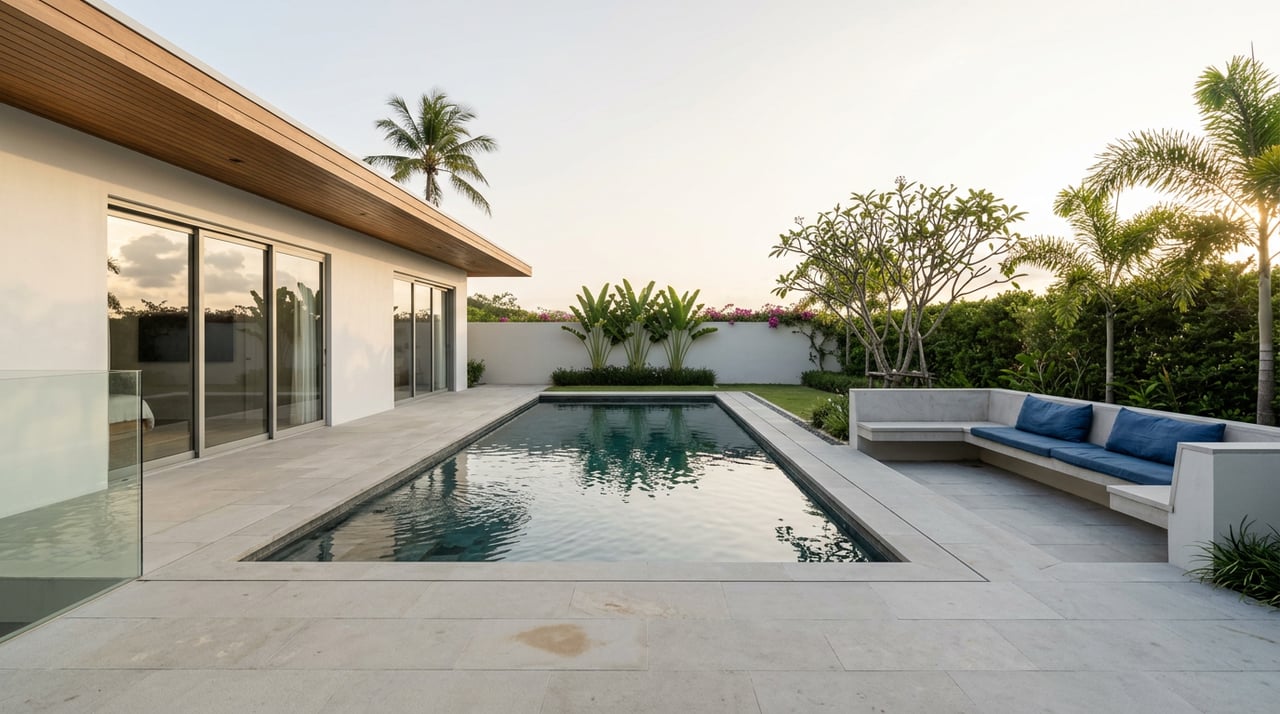
The Trailhead Is Behind the Gate. For Waialae Iki, That's Just Tuesday.
September 10, 2026
September 10, 2026
Somewhere around 6:45 on a clear weekday morning, a guard at the top of Laukahi Street is already writing down license plates. Not because anything is wrong. Because that's the job. The car in front of him isn't lost and isn't visiting a resident. It's someone who found the Wiliwilinui Ridge Trail on a hiking app the night before and drove up expecting a normal trailhead parking lot. What they get instead is a guardhouse, a laminated pass, and an explanation of how many spaces are left today.
This is one aspect of living on Waialae Iki. The ridge has some of East Honolulu's most protected ocean and Diamond Head sightlines, and it also happens to sit at the base of one of Oahu's most searched-for hikes. The popular public trail is accessed through a private, gated community, where a guard manages entry.
The Wiliwilinui Ridge Trail trailhead sits on Okoa Street, inside the gated Waialae Iki V subdivision, reached by driving up Laukahi Street to the guard station. From there it's close to a five-mile round trip up a ridge that tops out just under 1,600 feet, with a summit view that stretches to Waikiki, Honolulu, Waimanalo, and Konahuanui, the tallest peak in the Koolau range. It's one of three sister ridge hikes in the area, alongside Kuliouou and Hawaii Loa, and locals generally rank it as the easiest entry point of the three, which is exactly why so many people who don't live here want to reach it.
Reaching the trail means passing through Waialae Iki V, a private, security-guarded community. Visitors access the trail through its guard station.
Ask anyone who has hiked Wiliwilinui recently what the entrance process looks like, and the details are consistent enough to treat as fact rather than folklore:
That last point matters more than it sounds. A hiker who books a rideshare to the trailhead without checking ahead doesn't just face an inconvenience. They face a walk of over a mile and a half round trip through private streets before the actual trail even starts.
None of this is new to anyone who has lived on the ridge for more than a season. It's one aspect of living at the base of a well-known hike. The guard gate serves residents and manages public trail access, with a limited number of parking passes available each day.
The trail itself has a reputation that shows up in review after review: muddy, with real erosion on the last stretch of stairs, and steep enough that ropes are strung along the worst sections to help hikers get up and down safely. That's a trail-conditions problem, but it's also a neighborhood-adjacent one. Erosion and washouts on public-adjacent land near a private community mean more foot traffic funneling through the same narrow access points, especially after Hawaii's wetter stretches, when hikers who might otherwise turn back keep going anyway.
It's a small detail, but it's the kind of thing that only shows up if you're paying attention to how a trail and a neighborhood actually interact, rather than treating them as two separate stories.
Here's where it helps to know that "Waialae Iki" isn't one single governing body. The Wai'alae Iki Ridge Community Association, known locally as WIRCA, represents the broader ridge community outside the gates. Waialae Iki V, where the trailhead sits, has its own separate gated HOA with its own guard station and security patrol, funded through member dues that are described as a fraction of what a typical gated community charges elsewhere. WIRCA describes its own membership as a quiet mix of working families, retirees, and military personnel, with protected view corridors as the community's most valued shared asset.
That split matters for anyone trying to understand daily life here. The security patrol that manages hiker traffic and the trailhead pass system isn't the same organization running community life on the rest of the ridge. Two associations, one hillside, two very different jobs. One protects views through its CC&Rs. The other manages trail access and issues parking passes.
There's a smaller story buried in WIRCA's own community updates that says something about how this neighborhood actually operates. A community update discussed a dead coconut rhinoceros beetle. Coconut rhinoceros beetle has been established on Oahu since a 2013 detection near Joint Base Pearl Harbor-Hickam, and the statewide response has since shifted from eradication to containment on this island specifically. Oahu residents are not required to report sightings the way homeowners on Kauai, Maui, or Hawaii Island still are, since containment (not eradication) is now the working strategy here.
That update was shared through the community association. It's a small thing, but it's consistent with everything else here: a ridge where people keep an eye on shared assets, whether that asset is a protected ocean view, a coconut palm, or a guard gate that a few hundred visitors pass through every week.
None of this shows up on a market report, and it shouldn't. It's not a home value story. It's a daily-texture story, and it's the kind of thing that only becomes visible once you've lived with it for a while: your street is a resident amenity and a public trailhead checkpoint at the same time, run by a guard station that answers to your HOA, not to the county or the state.
If you already live on Waialae Iki, none of this is news. You've been waved through the gate, or waited behind a confused hiker's car, or read the same WIRCA update about the beetle. The point isn't to tell you something you don't know. It's to put a name to something you've experienced but maybe never seen written down: a ridge that quietly does double duty as one of Oahu's more popular hiking gateways, managed one parking pass at a time.
If you're weighing a move to the ridge, or thinking about what your own Waialae Iki property is worth in a market where view lots and lower-slope homes behave very differently, that's a conversation worth having with someone who actually knows this hillside street by street. Hawaii LUX Team works this neighborhood directly and can walk you through what a Wiliwilinui-adjacent address means for privacy, access, and resale, beyond what any hiking app or trail review will tell you. Get Your Free Home Valuation and start with a conversation grounded in the ridge you actually live on.
This article is general information, not legal, tax or financial advice. Consult a qualified professional about your situation.
October 22, 2026
October 15, 2026
October 8, 2026
October 1, 2026
September 24, 2026
September 17, 2026
September 10, 2026
September 3, 2026
August 27, 2026
Get assistance in determining current property value, crafting a competitive offer, writing and negotiating a contract, and much more. Contact us today.